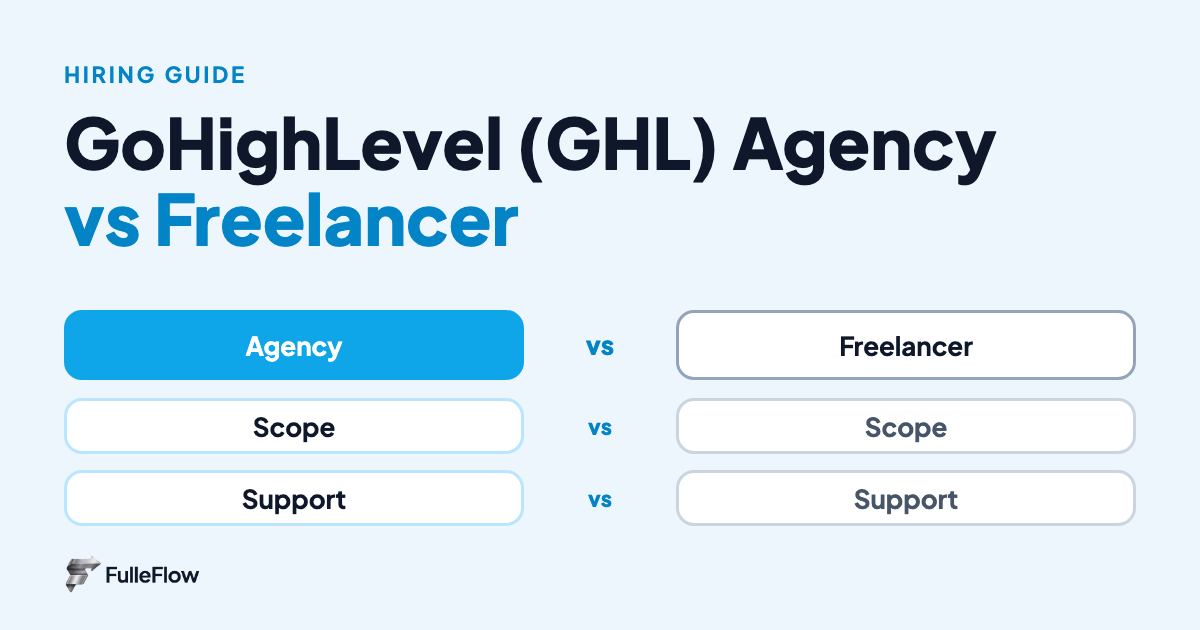
Short answer: Hire a freelancer when the job is small, well defined and low risk, such as a single pipeline or a quick fix. Hire an agency when the work is larger, spans several skills, needs ongoing support, or the business depends on it running without one person’s availability. The right choice depends on scope, risk and continuity, not on price alone.
We are a team of GoHighLevel specialists, so we have an interest in this topic. We have tried to be fair to both options.
Quick verdict
| Your situation | Usually a better fit |
|---|---|
| One pipeline, a few automations, a clear spec | Freelancer |
| A one-off fix or a second pair of eyes on your build | Freelancer |
| You already have an in-house owner who manages the account | Freelancer for specific tasks |
| Several pipelines, a migration, SMS compliance and reporting at once | Agency |
| You run an agency and need reliable delivery for your own clients | Agency, or a long-term specialist partner |
| You need ongoing support, not only a build | Agency, or a freelancer on a retainer with a written scope |
| You want a documented handover and a backup if someone is unavailable | Agency |
What is the main difference between a GHL agency and a freelancer?
The main difference is how the work is covered, not how skilled the person is. A freelancer is one person with their own skills, schedule and process. An agency is a team with defined roles, shared processes and some cover if one person is away.
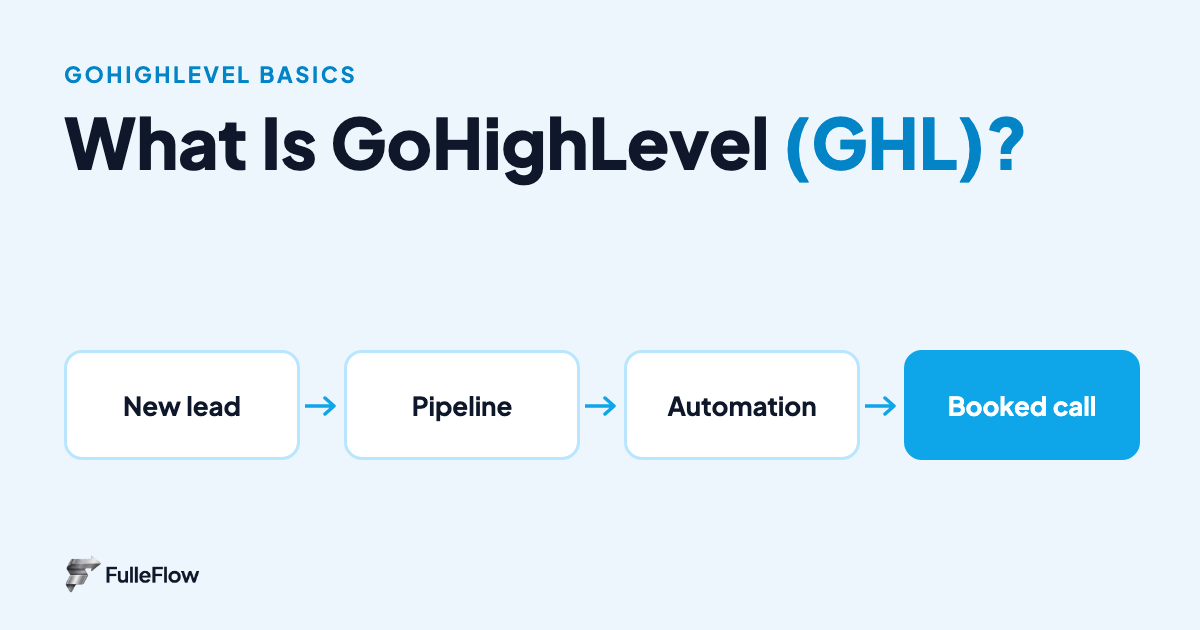
Both can build a good GoHighLevel (GHL) system. Many freelancers are excellent. The question is how well each model fits the size and risk of your project. For background on the platform itself, see our guide to what GoHighLevel is.
When does a freelancer make sense?
A freelancer is often a good choice when:
- The scope is narrow. For example, “build one lead-capture funnel and a missed-call text back.”
- You can describe what you want. If you can write a clear brief with examples, a freelancer can usually work from it.
- The cost of a mistake is low. A small automation that fails is an annoyance, not a crisis.
- You will manage the account yourself. You are comfortable reviewing the work, testing it and making small changes later.
- You want to hire for a specific skill. Some freelancers specialize in one area, such as workflows, design or API work.
Freelancers can also be more flexible and informal, which suits fast, small jobs.
When does an agency make sense?
An agency is often a better fit when:
- The project has several moving parts. A typical example is a CRM migration, pipelines, automations, forms, calendars, phone numbers and compliance registration in the same project.
- Several skills are needed. Design, copywriting, workflow logic, integrations and testing rarely sit in one person.
- Continuity matters. If your leads and bookings run through this system, you want someone covering it if a person is sick, busy or gone.
- You need a process. Discovery, documented build, testing, handover and a defined way to request changes.
- You are an agency yourself. Delivering to your own clients adds pressure, because your reputation sits on the build.
- You need ongoing work. Support, optimization and new builds are easier when a team owns them.
An agency usually costs more per hour than a solo freelancer, but the real comparison is cost per outcome, including rework and downtime.
How do agencies and freelancers compare on cost?
We do not quote prices in this guide, because rates vary widely by region, experience and scope, and published numbers go out of date quickly. What we can say is how to compare cost fairly.
| Cost factor | Freelancer | Agency |
|---|---|---|
| Hourly or project rate | Often lower on paper | Often higher on paper |
| Scoping and discovery | May be minimal | Usually a defined step |
| Testing and quality checks | Depends on the individual | Usually part of the process |
| Rework if something breaks | Check what the agreement covers | Check what the agreement covers |
| Cover for illness or time off | Usually none | Usually a team |
| Documentation and handover | Varies | Usually included in scope |
| Ongoing support | Varies | Often offered under a defined plan |
For our own work, we give a scoped quote after a free audit. See our pricing page for how our packages are structured.
What are the biggest risks with each option?
Every model has risks. Knowing them lets you reduce them.
Common freelancer risks
- Single point of failure. One person holds all the knowledge.
- Availability. A freelancer with several clients may be slow to respond.
- Unclear scope. Without a written brief, jobs can drift.
- Weak documentation. If the build is not documented, the next person has a hard time.
Common agency risks
- Handoffs between people. Information can get lost between sales, project management and the builder.
- Junior staff doing senior work. Ask who will actually build your system.
- Template thinking. Some agencies apply the same build to every client. Ask how your needs will shape it.
- Higher minimums. Small jobs may not fit an agency’s process.
Risks that apply to both
- Account access. Make sure your account sits in your own name, and that you hold admin access. Never hand over the only login.
- Misleading claims. Be careful with promises of guaranteed results, badges or credentials you cannot verify, or testimonials you cannot check.
- No testing. Ask how forms, workflows, messages and calendars are tested before launch.
What should you ask before hiring anyone?
Use the same questions for a freelancer or an agency.
- Who will build my system, and who covers them if they are unavailable?
- Can you show relevant work and let me speak to a reference?
- What will you deliver, in writing? Pipelines, automations, forms, calendars, integrations, documentation.
- How do you test before launch?
- Who owns the account and the assets? The answer should be you.
- What happens after launch? Is there a support period, or are changes billed separately?
- How do you handle SMS and phone compliance? In the US, this includes carrier registration.
- What do you need from me? Good providers ask for access, content, decisions and approvals.
- How do you handle changes to scope?
- What do you do if the build does not work as expected?
A provider who answers these clearly and in writing is usually a safer choice than one who answers confidently but vaguely.
What about a hybrid approach?
You do not have to choose one model forever. Common hybrids include:
- Agency for the build, freelancer or in-house staff for day-to-day changes. This works best when the agency documents the system and trains your team.
- Freelancer for the build, agency for an audit. A second review can catch problems before launch. Our free audit call is built for that.
- Agency as a white-label partner. If you run an agency, a specialist team can build or support client accounts under your brand. See our white label GoHighLevel service.
What are the warning signs on either side?
Be careful when you see:
- No written scope or deliverables.
- Pressure to hand over your only admin login.
- Claims of guaranteed results or rankings.
- No questions about your business, only a price.
- Refusal to explain how the system will be documented or handed over.
- A portfolio that you cannot verify.
How does FulleFlow work with clients?
We are a team of GoHighLevel specialists working with agencies and businesses in the US, UK and Australia. Our approach begins with a free audit, followed by a scoped plan. You can read about our GoHighLevel implementation service, our done-for-you packages, and our ongoing support offering. If you prefer a dedicated person, see hire a GoHighLevel expert.
We are not the right fit for every project. If your job is small and clearly defined, a freelancer may serve you well, and we would say so on the audit call.
Frequently asked questions
Is a GHL agency better than a freelancer?
Neither is better in every case. A freelancer suits small, clearly defined jobs. An agency suits larger projects with several skills, ongoing support needs, or where continuity matters. Compare scope, risk and cover, not just price.
Is it cheaper to hire a GoHighLevel freelancer?
A freelancer often has a lower rate on paper, but total cost depends on rework, testing, downtime and support. Compare written scopes side by side, and ask what is included before you decide on price.
What should I look for when hiring a GoHighLevel expert?
Look for a written scope, relevant examples you can verify, a clear testing process, documentation, and a commitment that the account stays in your name. Ask who covers the work if the builder is unavailable.
Can I switch from a freelancer to an agency later?
Yes. A documented build makes the switch easier. Ask your freelancer for notes on workflows, custom fields, integrations and logins. If documentation is missing, an audit can map what exists before anyone changes it.
Who should own my GoHighLevel account?
You should. Keep your account under your own login and billing, and give providers the access they need rather than handing over the only admin login. Confirm this in writing before work begins.
Does an agency offer ongoing support?
Many do, but the terms vary. Ask what is included, how requests are made and how quickly they are handled, and get the details in writing. Our support offering is described on our GoHighLevel support page.
Not sure which option fits your project?
Book a free audit call. We will look at your current setup or plan, tell you honestly what the job involves, and say whether a freelancer, an agency or a mix would suit you. You leave with a clear next step either way.
This guide is general information, not legal or financial advice.